
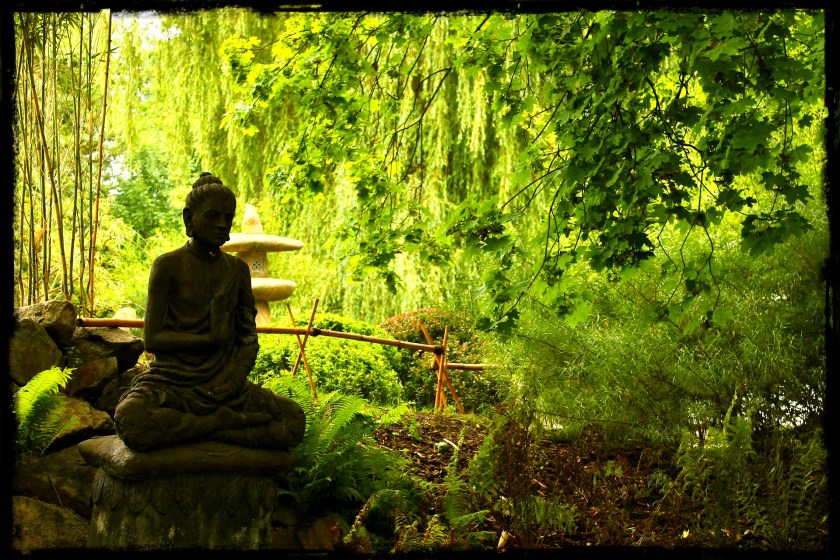
I don’t think that the Buddha’s disciples, when their master was not present, placed a statuette of him in the middle of the room.
If that had been the case, when he came back, he would undoubtedly have pointed out the uselessness of such a habit.
They just didn’t do it because they didn’t feel the need.
The warmth of the Awakened One still radiated when they were together.
The need began to emerge as the Awakened One moved away.
When the awakening faded away.
In the space that generations of stories began to accumulate between the disciples and the warmth of the awakened, the statue is a photo of being.
A photo of the hearth: it recalls, it evokes fire, but does not warm.
It is nevertheless relevant when it comes to telling someone about fire who has never seen it.
As soon as the apprentice encounters a crackling fireplace, the image loses its appeal.
It is an educational vector which condenses symbolic power (etymological meaning).
The error creeps in slowly when we give the reminding object the features or the object reminding.
Also, it is possible for the disciple to be both the statue…and the Buddha.
Which is equivalent to doing without a statue, not in a movement of rejection but resulting from the loss of its symbolic power as soon as it is united again within.
The straight line (buddha-statue) is traced again.
Then the Buddha himself disappears, taking the statue and the disciple along with him.
It is always a healthy call in a spiritual practice to question our relationship to the ritual support
So, to what extent does this actually accounts, not for the fervor of my practice but tells about my distance, from the authentic source of this practice?
How can we break through the layers of habit and stories that have accumulated between the awakened and the disciple?
©FJ May 2024
Recueils / Participation/ Groupe De Pratique
 Notes & Silence
There is a danger of a sort of legalistic refutation of imagery. That was responsible for a good deal of puritanical destruction of ecclesiastical art.
There is a danger of elevating the art to the status of what it represents.
Let a statue be a statue, having its value in the artistry. Let ritual be for those that need it, having its value in what they get from it. Let it be laid aside when no longer needed.
As to questioning, I tend to come back to the words of Aleister Crowley from The Book of Lies (quoted from memory):
« I slept with faith, and found a corpse in my arms on awakening. I danced and drank all night with doubt, and found her a virgin in the morning. »
J’aimeAimé par 1 personne
Non-attachment to imagery and statue is an expression of what is generally referred to as the Middle Way, I guess.
Great quote by Crowley…Thanks Simon..
J’aimeAimé par 1 personne