
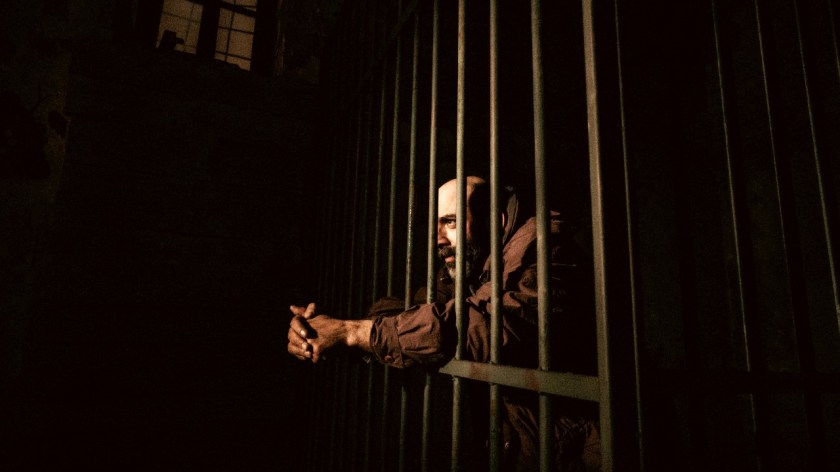
The veil of beliefs is so thick that it is already very rare to be able to perceive the presence of a veil.
We mistake this thick veil for reality.
How difficult it is to connect with reality when we can’t even perceive the very existence of what keeps us at a distance…
Generally, what we can’t see is difficult to disintegrate.
In the case of the veil of belief, it’s the dense texture and our proximity that keeps us at a distance.
We don’t perceive the nature of these beliefs; we mistake them for something real.
We don’t perceive the belief nature of beliefs.
Our entire experience, inner and outer, is based on an artificial density. We lean on thin air, thinking we’re supported by solid material. The courage of experience, emptiness, is also here understanding that there is no density through which we cannot pass, that what we have aggregated to constitute « our world » has no existence.
Liberation is on the other side of the walls of beliefs.
The walls of beliefs are social, psychological, familial, professional, friendly, religious, spiritual, physical.
No one but ourselves has strengthened the walls.
No one but ourselves has woven such veils.
We were the architects of our penal institution.
 Notes & Silence
Then it seems belief is an act of self-delusion. That veil is not easy to let drop.
J’aimeAimé par 1 personne
Beliefs are to be observed for what they are.
I make a difference between beliefs and faith.
The latter I understand as anchoring, abiding.
J’aimeAimé par 1 personne
« Faith » to me is belief hardened into irrationality. It certainly abides, but the anchor chain needs to break.
J’aimeAimé par 1 personne
We had, I believe, this discussion before.
The way I use faith is unexpected, very unconventional.
…and derived from « your faith has healed you ».
That which heals is not a set of beliefs one grips to, a validation of boxes to win the prize of healing.
But abiding, anchoring
in deep water.
(Lk 5, 4)
J’aimeAimé par 1 personne
Yes, I recall something similar being said at some point.
Perhaps I am the more iconoclastic of us… perhaps we both say the same but in words too individually understood to be seen easily as coinciding…
J’aimeAimé par 1 personne
I recall we also recently mentioned the lack of reliability regarding any self-referential statement…
Does it work with iconoclastic as well?
J’aimeAimé par 1 personne
Only if the word is not prefaced with something like « perhaps ».
Certainty, as I tend to say, is overrated.
J’aimeAimé par 1 personne
You lawyers…
J’aimeAimé par 1 personne
I know. I hate them…
J’aimeAimé par 1 personne
Yet another lawyer trick
J’aimeAimé par 1 personne
You are displaying impressively legalistic cynicism.
J’aimeAimé par 1 personne
Cynicism is in the mouth of the beholder.
How dare you call cynicism my relentless quest for authenticity?
(cynicism squared?)
J’aimeAimé par 1 personne
Because I’m a lawyer, and they always dare.
Because your relentless search informs your suspicion of anything you feel possibly inauthentic.
Because it has caused you to make a self-referential statement of being a relentless searcher.
Because Diogenes would have approved.
J’aimeAimé par 1 personne
Aren’t you growing a bit old, Simon, to still feed a search for approval ?
My guess is Diogenes wouldn’t have cared the least about all this.
I believe self referential statements are prowling everywhere and we d better remain in safe territory, making pointless and unneeded other-referential claims.
J’aimeAimé par 1 personne
I’m growing a bit old for many things, and actually could not care less if anyone approves (if you can trust anything I say about myself, which, to be pointlessly other-referential, you cannot). But the Diogenes reference was irresistably ironic.
J’aimeAimé par 1 personne
I trust you Simon,
Even when embarked on a self-referential spree.
I responded in a cheeky and playful tone, as (you) often (do)…
J’aimeAimé par 1 personne
Yes, I noticed. My response, also, was meant to be heavy on the dry humour – perhaps overly dry, in this instance…!
J’aimeAimé par 1 personne