
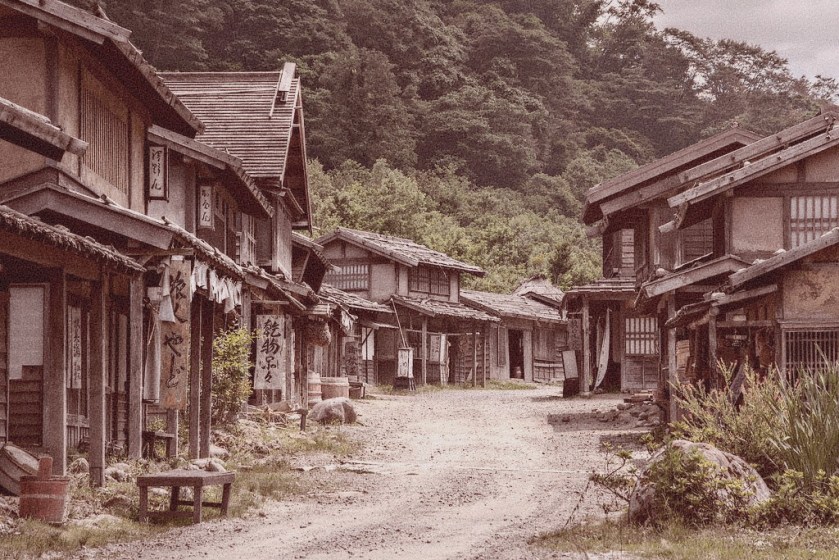
I sometimes have the impression that religions, with their array of texts and practices, are so many artificial sets placed in infinity.
I think back to Huang Po’s expression: « ghost towns, » which didn’t specifically apply to religions but nevertheless included them.
Cardboard buildings and entertainment activities.
In retirement homes or institutions for people with disabilities, and for specific educational purposes, reconstructions of environments are also planned to simulate various situations.
Religions of smoke and mirrors and their trappings only exist for those who wander through them.
They are themselves the foundations upon which other belief systems and worldviews are built.
To borrow Huang Po’s words, religions are ghost towns; they serve as the foundation for the construction of other cities made of papier-mâché. They have no real existence, like mirages seen in the vast desert.
Ghost towns, they are structures populated by ghosts.
Religions nourish, feed, entertain, and occupy the beings who move within them. Illusory structures fulfill humanity’s tendency toward illusion.
Reconnecting with the infinitude of reality tends to diminish the allure of illusory cities, of refuges in the clouds.
Reconnecting with the infinitude of our deepest nature tends to allow us to perceive religions in the same way that we perceive, upon waking, a place visited in a dream.
In a dream, we cling to its reality; upon waking, it means (almost) nothing.

